Bukit Dinding Birdsound Atlas
One recording day · 86 clips · 11 species
From a pre-dawn phantom call to a dusk chorus, one day of sound becomes a living map.
Click or tap a dot to hear a moment from the forest, or start with the dawn chorus.
A circular overview of detections across the full day. The hero wheel can be explored dot by dot to play clips. Use the “Experience the Dawn Chorus” and “Explore the atlas” controls to begin, or move through the wheel’s interactive dots directly. Additional preview-audio settings are available in the hero options disclosure.
How to read the hero wheel
- Each dot marks a 3-second BirdNET detection window, not a confirmed field identification. Playback uses a longer context clip.
- The wheel follows your confidence threshold and any species filters you’ve applied.
- The wheel always shows the full day, even when other views are focused on a smaller time window.
- Click a dot to play its full clip in the listening bar below.
- Preview clips are optional and stay off by default. Play any clip once to enable them.
- This atlas covers one day at one site. It is not a census.
Rows are species; dots are clips over time.
These labels are rough guidance; listen to clips to validate.
Higher = fewer, cleaner clips; lower = more, noisier.
Context
The Green Lung
An island of sound in the urban sprawl.
Bukit Dinding constitutes a vital ecological asset within Kuala Lumpur. Encompassing more than 300 acres and rising 291 meters, this former rubber estate has naturally regenerated into a thriving secondary forest. It is early May; the air is 24°C with heavy 90% humidity. To understand who lives in this green lung, we just have to listen. Every dot on this timeline is an bird sound clip flagged by a neural network over a single 24-hour period.
Detected
The Midnight Phantom
A haunting hoot in the darkness.
Listen for: A soft, rhythmic hoot—"hoo-hoo-hoo"
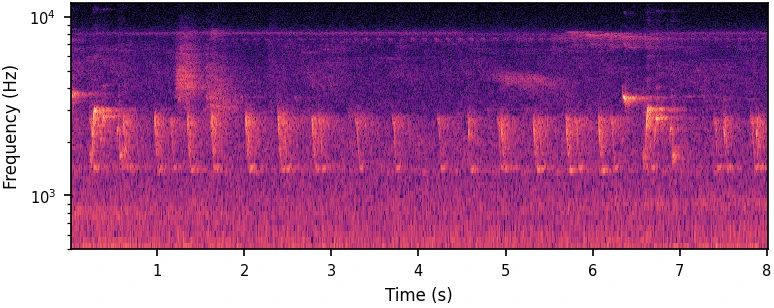
It is 03:55 AM. The forest is a world of shadows. Then, cutting through the stillness: the hoot of a Collared Scops-owl. The call is low, deliberate, a whisper from the treetops. It lingers, then fades, leaving only the hum of insects and the rustle of unseen movement.
Detected
The First Awakening
The undergrowth stirs before the sun rises.
Listen for: Hard, chopping "chonk-chonk-chonk" notes, repeated in steady bursts.
At 06:50 AM, the true forest residents begin to vocalize. The Pin-striped Tit-Babbler, a small, highly vocal bird of the dense understory, is the first to claim the acoustic space. Moving in agitated little flocks through the vines and bamboo, they cut through the lingering nocturnal hum of insects.
Detected
The Dawn Chorus
The chorus changes shape as the canopy catches the light.
Listen for: A bubbly, clipped chirruping song ("whip wi-wiu").
By 07:05, the first rush has started to loosen. The Pin-striped Tit-Babblers are still working the undergrowth, but now Olive-winged Bulbuls cut in from the forest edge. It feels less like a single outburst than a handoff: the hard chopping notes of dawn giving way to brighter, more fluid calls as the hill begins to warm.
Natural history
The Canopy Watcher
Activity shifts higher into the trees as morning progresses.
Listen for: A dry, harsh "skatch-skatch" delivered in a short, scolding series.
At 08:35, the algorithm isolates the Large Woodshrike. A grey-and-white resident of the mid-storey and canopy, this bird often moves with mixed-species foraging flocks. When disturbed, its harsh warning calls carry clearly down from the treetops to the forest floor.
Detected
The Midday Contraction
The soundscape thins in the equatorial heat.
Listen for: A sharp, isolated, metallic "ink" note.
By 12:20 PM, the temperature peaks at 33°C (91°F). The rules of the forest change. The timeline opens up into longer silences, with only scattered calls breaking through the heat. The dense morning chorus is replaced by the sparse, ringing calls of the Asian Glossy Starling—a sleek, red-eyed urban adapter moving between fruiting trees in the midday glare.
Detected
The Afternoon Break
A brief metallic flare in the long, hot quiet.
Listen for: A clean, metallic "ink" note, followed by another a few seconds later.
By 16:05, the day has gone slack with heat. Then two short notes ring out from an Asian Glossy Starling. It is a small moment, almost easy to miss, but that is what the late afternoon sounds like here now: not a chorus, just quick signals from birds moving between fruiting trees before evening gathers.
Data literacy
Dusk's Second Bloom
A final, quieter surge before night falls.
Listen for: The cheerful, rolling "gloo-gloo-gloo" gurgle of the Yellow-vented Bulbul.
Around 18:00, the oppressive heat lifts and the forest experiences a 'second bloom' of sound. Bulbuls return to vocalize one last time. Notice that the model's confidence here is lower (around 60%). If we raised our strictness threshold to 80%, this dusk chorus would vanish from the chart entirely. In bioacoustics, finding the line between "capturing reality" and "filtering out the noise" is a delicate balance.
Explore
Handing Over the Binoculars
The day belongs to you.
You have followed the pulse of Bukit Dinding through a single rotation of the earth, guided by AI detections. But this is just one path through the data. Now take the controls.